
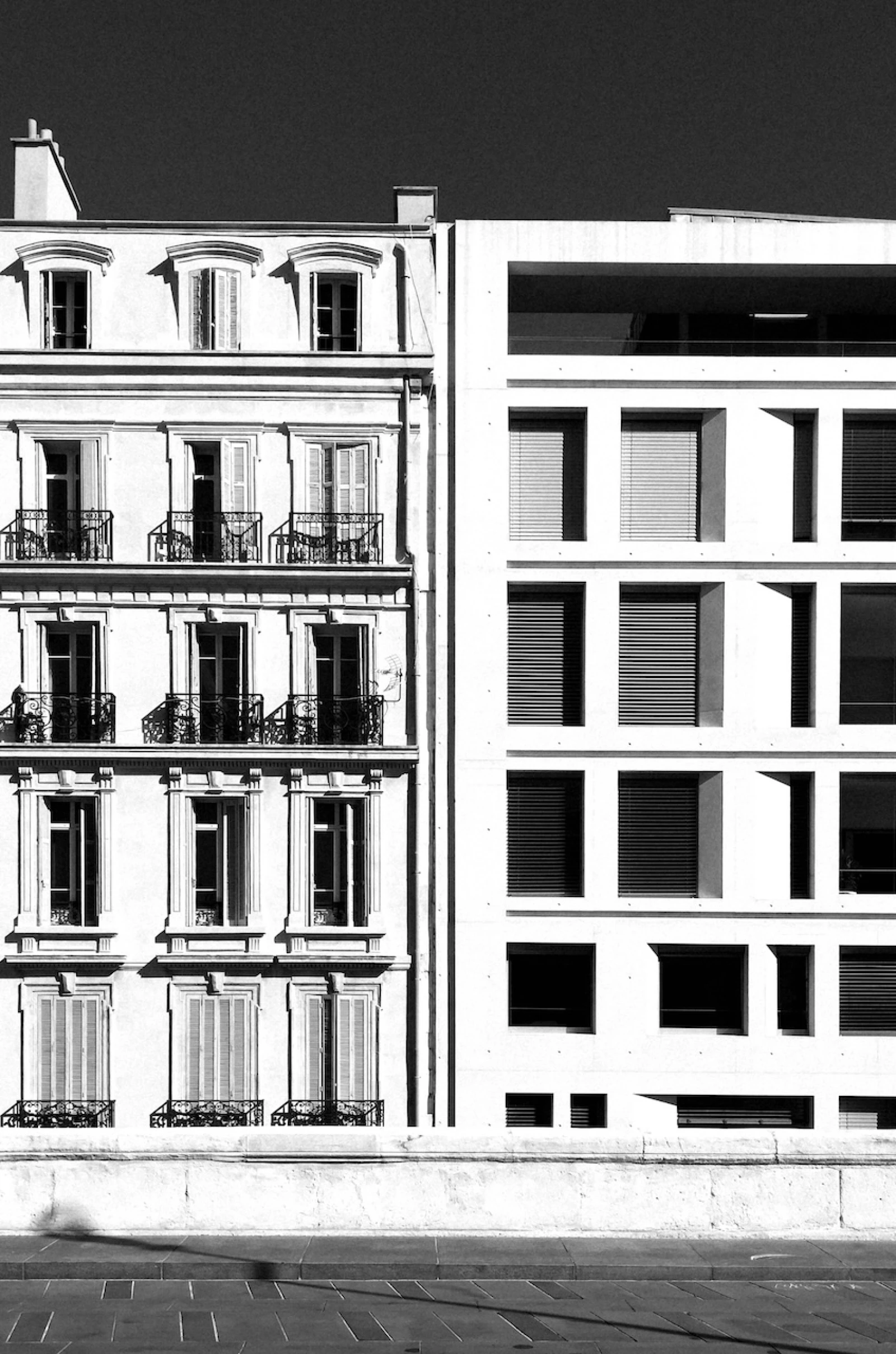
Esplanade Jean-Paul II
AI-GENERATED CRITIQUE
This is a striking architectural photograph that finds something almost severe in the familiar streetscape of Marseille. Its greatest strength is the division between the two buildings: the ornate nineteenth-century façade on the left and the stark modernist structure on the right form a diagrammatic confrontation between two architectural languages.
The image works particularly well in black and white. The intense Mediterranean sunlight has been reduced to hard planes of white and black, bringing out every balcony railing, shutter, cornice and window recess. The older building is exuberantly decorative, its wrought-iron balconies and mouldings creating a dense visual rhythm, while the newer building is characterised by repetition, grids and blank surfaces. One feels the photograph asking whether these two buildings belong to the same city—let alone the same street.
The vertical seam between the buildings is the photograph's crucial compositional element. It acts almost like a fault line. On one side there is ornament, individuality and accumulated history; on the other, abstraction and repetition. The contrast is sufficiently strong that the buildings become symbolic rather than merely architectural.
The low viewpoint and frontal composition also give the photograph a pleasing graphic quality. There is very little perspective distortion, so the façades read like pages in an architectural book. The pavement and parapet at the bottom provide a grounding horizontal band, while the huge expanse of dark sky creates a dramatic negative space above.
There is also something quietly unsettling about the photograph. The windows are mostly closed, shuttered or dark, and there are no people visible. Marseille's reputation for movement, colour and street life is temporarily absent. Instead, the city becomes a stage after the actors have left.
The image feels less like a conventional city photograph than an architectural still life—Marseille reduced to light, geometry, history and collision.