
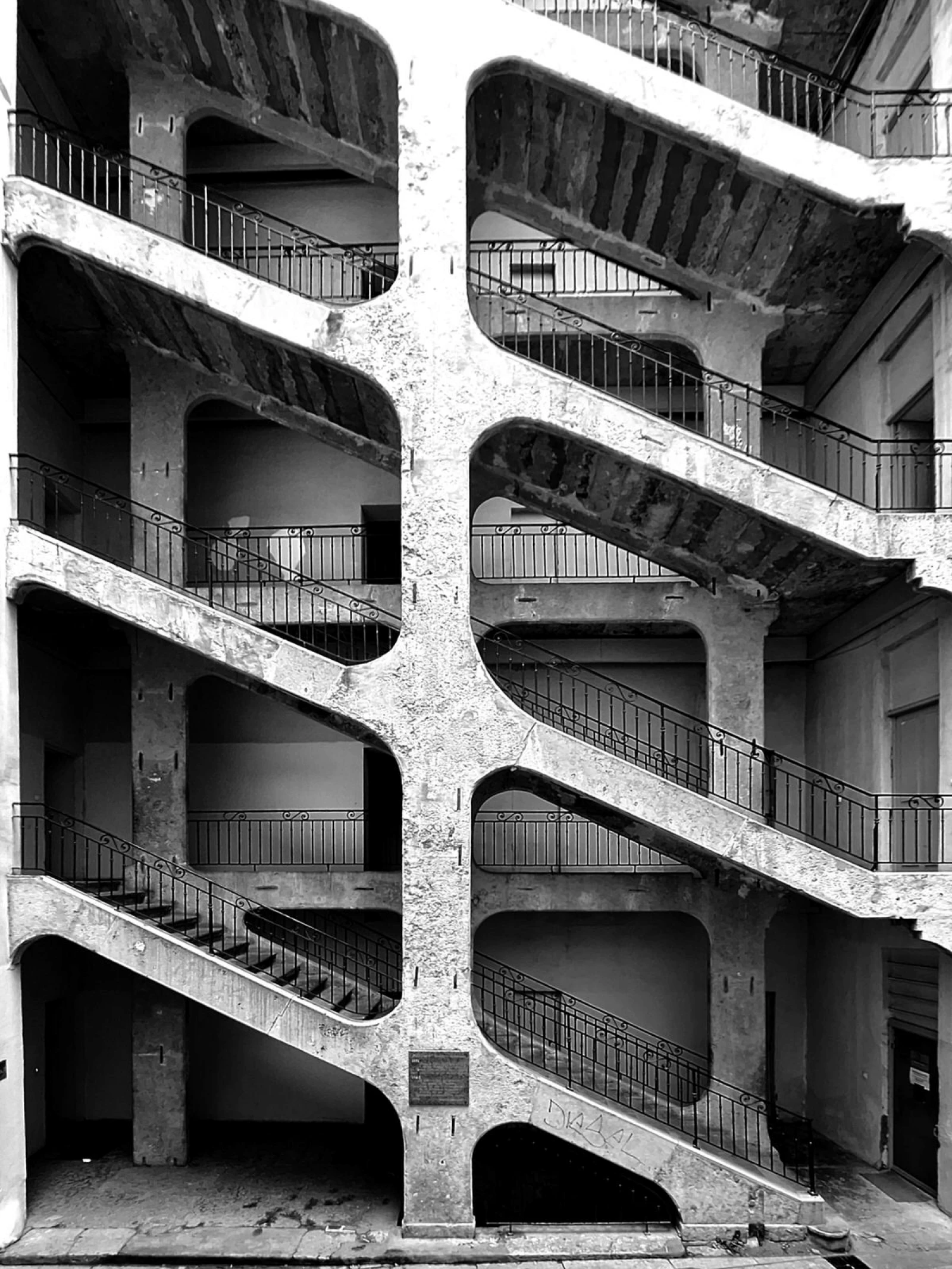
Cour des Voraces
AI-GENERATED CRITIQUE
This is a striking architectural photograph that treats the Cour des Voraces less as a historic monument than as an almost abstract machine of stone, concrete and iron. The decision to work in black and white is particularly effective: it strips away the distractions of colour and makes the image about structure, rhythm, texture and light.
The strongest feature is the extraordinary repetition of the staircases. Their diagonal flights slice across the frame, creating a dense geometric pattern that initially feels impossible to decipher. The central vertical column provides an essential anchor, preventing the composition from becoming completely chaotic. From it, the stairways seem to grow like branches, while the railings produce hundreds of fine vertical and horizontal lines. The result sits somewhere between Escher, Brutalist architecture and industrial theatre.
There is also a wonderful tension between the precision of the geometry and the roughness of the building. The weathered surfaces, exposed flagstones and peeling plasterwork are beautifully rendered in monochrome. The photograph doesn't romanticise the architecture; instead, it emphasises its age and physical labour. That seems particularly appropriate for a building associated with Lyon's nineteenth-century silk workers and the revolutionary history of les canuts.
The tonal range is another strength. The deep shadows beneath the staircases contrast dramatically with the almost luminous surfaces of the walls. These dark recesses create a sense of mystery: the photograph suggests that there are passages and spaces beyond what we can see. That quality is particularly appropriate: Lyon's traboules are ancient hidden passageways that enabled workers to move easily through and between buildings.
Compositionally, the photograph is admirably uncompromising. By resisting the temptation to include a person for scale, the architecture feels strangely monumental and slightly oppressive. At the same time, the absence of human figures leaves the viewer to mentally inhabit the space, following the stairs upward and sideways and trying to work out where each flight leads.
This very successful architectural study transforms a famous Lyonnais landmark into a study in geometry, decay, repetition and hidden movement. Rather than simply recording the Cour des Voraces, it makes the building feel enigmatic and slightly surreal—as though the staircase has become an organism that has taken over the entire courtyard.