
Col de la Colombière
AI-GENERATED CRITIQUE
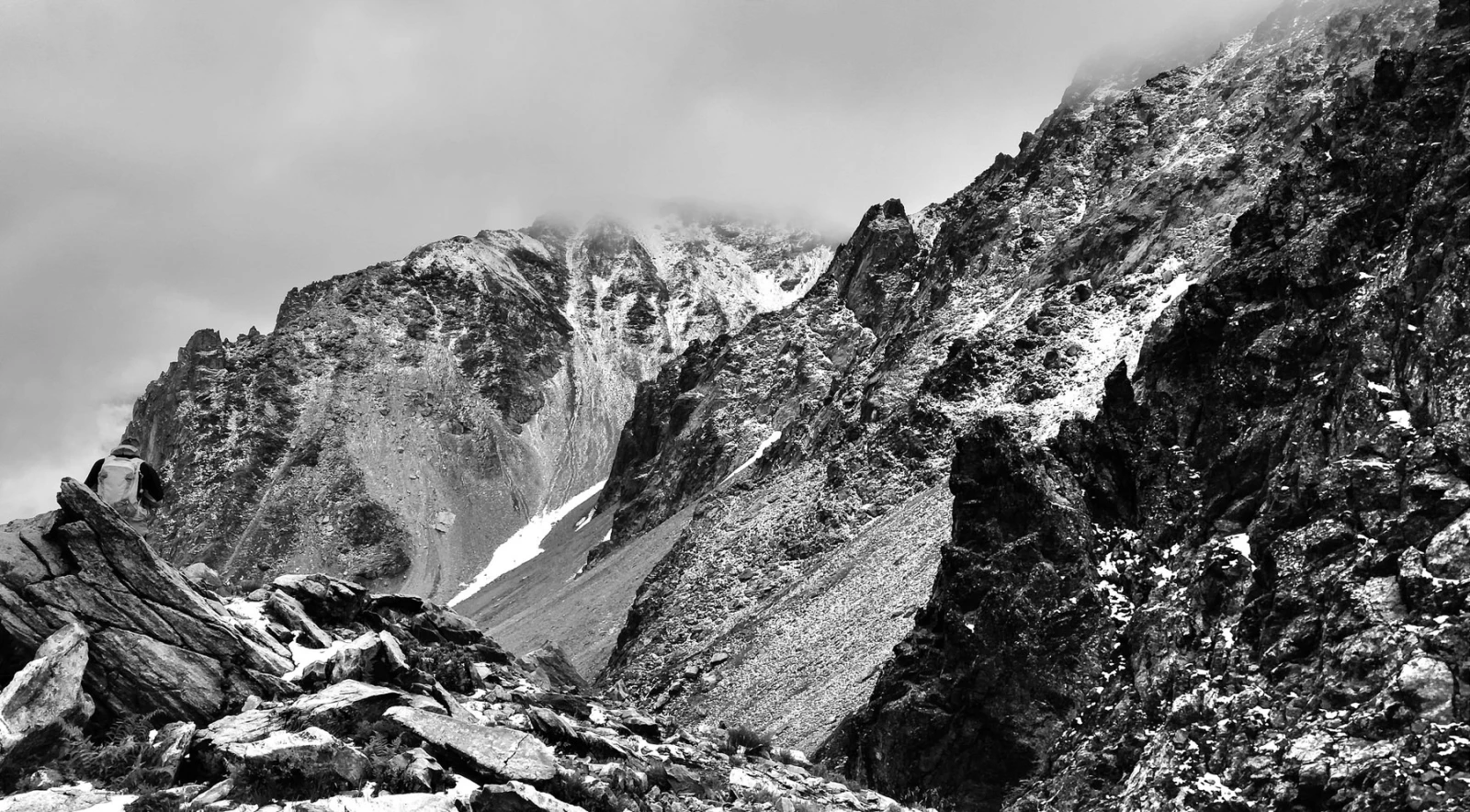
This is a powerful mountain photograph. Its greatest strength is the way it turns the landscape into something almost architectural. Taken at the 2230m Col de la Colombière, the image presents the Alps not as a picturesque panorama but as a severe, fractured environment of rock, snow and cloud.
The composition is particularly effective because of its layered depth. The climber at lower left provides an essential human scale, while the enormous rock faces rise behind and to the right, making the figure appear almost insignificant. The eye is drawn from the foreground rocks towards the narrow snow-filled gully and then upward into the mist. That progression gives the photograph a strong sense of ascent.
The black-and-white treatment is an excellent choice. Colour might have made the scene more conventionally scenic; monochrome instead emphasises texture and structure. The snow becomes luminous against the dark volcanic-looking rock, while the heavily worked mid-tones describe the complex surfaces of the mountains. The high contrast also gives the photograph a distinctly dramatic, nineteenth-century quality.
The mist is perhaps the photograph's most atmospheric element. It conceals the summits rather than revealing them, creating a sense that the mountain continues beyond the frame and beyond visibility. This withholding is important: the photograph becomes less about documenting a particular peak and more about conveying the scale and mystery of the high mountains.
There is also a pleasing tension between the static monumentality of the landscape and the fragility of the tiny figure. The climber seems to be caught in a moment of reflection, in awe of the scenery, reinforcing the impression of vulnerability. The jagged foreground rocks further contribute to the physicality of the terrain.
Overall, this is a dramatic and convincingly atmospheric mountain photograph. Its success lies less in recording a beautiful Alpine view than in communicating the mountain as an imposing physical presence. The diminutive figure, disappearing summit and stark monochrome palette turn what might have been a scenic record into something closer to a study of human insignificance in a hostile landscape.